

THANK YOU FOR SUBSCRIBING

Pharma Tech Outlook Weekly Brief
Be first to read the latest tech news, Industry Leader's Insights, and CIO interviews of medium and large enterprises exclusively from Pharma Tech Outlook


 Dr. George Y. Li, Founder and President
CombiPhos Catalysts is changing this scenario with a platform designed to convert deuteration from a single switch into a strategic engine for program drug design, IP protection, and maximizing the application of approved drugs and drug candidates in development.
Derived from DuPont Central R&D’s combinatorial catalysis heritage and augmented by specialty catalyst assets competitors have not replicated, CombiPhos has spent two decades translating homogeneous catalysis into site specific deuteration that discovery teams can deploy early and at scale. The company positions itself as the world’s largest advanced deuterium reagent supplier and a deuterated CRO, serving more than 1,000 biopharma and materials clients across 22 countries with over 10,000 deuterated products and 1,000 new reagents developed each year. Founder and president Dr. George Y. Li and company consultant Roy Delizia describe an execution first identity that has earned “producer of last resort” mandates; with more than 100 custom deuterated analog requests fulfilled without a miss, for projects other providers decline.
 “Most pharmaceutical companies use off-the-shelf starting materials and miss the real advantages because deuterium chemistry is difficult, which is exactly where we focus,” says Dr. Li.
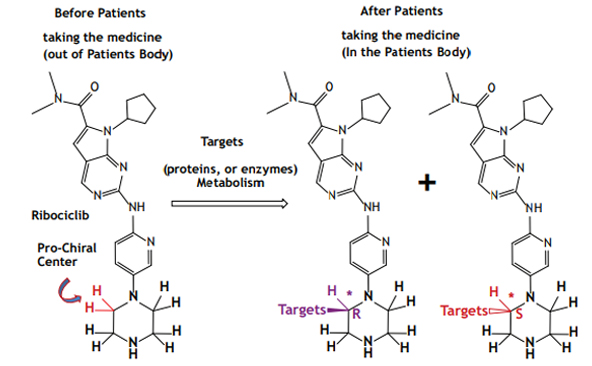
CombiPhos advances a non radioactive isotopic approach that blends deuterium’s KIE, and deuterium atoms as new “blocking” groups instead of just swapping out hydrogen atoms with deuterium to slow metabolism (as is common) with proprietary chiral control strategies to address a persistent blind spot: in vivo emergence of chirality that can result in half of the drug being inactive and/or even counterproductive, because only one “handed” form (enantiomer) of the molecule may be effective. Traditional methods cannot effectively predict, control, and fix this issue because of the chirality to be only produced in vivo. By instrumenting metabolically essential positions, carefully placed deuterium by catalysis can slow rate determining C–H oxidations or metabolism and bias enantioselective pathways, improving net efficacy and toxicity profiles in ways conventional workflows leave to chance. Ribociclib is cited as an illustrative scaffold class for the pro chiral to chiral transition under metabolism, underscoring why stereochemical outcomes must be engineered rather than assumed.
The operating model is deliberately quiet. Core method know how is kept out of conferences and public patents to preserve lead time, with partner education delivered selectively and differentiation proven through delivery. The practical guidance to R&D leaders is outcome first: specify liabilities such as metabolic hot spots, exposure targets, stereochemical instability, and resistance vectors. Commission multi site panels across four to five positions; then run deuterated variants head to head with the hydrogen series in the same assays used to gate programs to generate evidence on exposure, metabolite suppression, activity, and tolerability before major spend. The same panelization supports a defensive IP posture on Phase 1 entrants by ring fencing multiple positions even when a deuterated clinical path is not immediately pursued.
A New Frontier in Oncology
Oncology is where the thesis is most urgent. Delizia points to claims from research in US and China that a specific mixed deuterated version of OSIMERTINIB showed stronger efficacy and delayed drug resistance compared to the commercial and/or regular deuterated OSIMERTINIB, noting that these remain speaker assertions awaiting peer-reviewed publication. Dr. Li adds that by using engineered deuteration alongside stereocontrol, it is possible to boost the proportion of a drug that is pharmacologically active, a key advantage in cases where new chiral centers would otherwise dilute exposure. He has suggested this approach can deliver major gains in efficacy and combination drugs in certain settings, while acknowledging limited public data due to the company’s secrecy posture.
In the next 18 to 24 months, CombiPhos expects deuteration to be institutionalized as a decision and IP tool early in development, particularly in portfolios advancing 20 to 30 small molecules from preclinical to Phase 1 each year. It also foresees expansion beyond pharma into OLED emitters and transport layers, blue-light optics, wellness, and specialty materials where isotopic substitution improves stability under heat, light, and oxidative stress.
The throughline though, remains consistent: deuterated drug libraries, integrated with AI-driven pharmaceutical R&D, engineered to real liabilities, and deuterium FTE/CRO models, to move the odds where it counts.
Company
CombiPhos Catalysts
Management
Dr. George Y. Li, Founder and President
Description
CombiPhos Catalysts is a Princeton-based catalytic technology company derived from DuPont Central R&D that specializes in novel homogeneous catalysis, rarely reported and historically “unstable” pharmaceutical intermediates, and advanced deuterium chemistry for drug discovery; it positions deuteration as a strategic engine for drug design, IP protection, maximizing the application of approved drugs and drug candidates in development, and oncology resilience.